
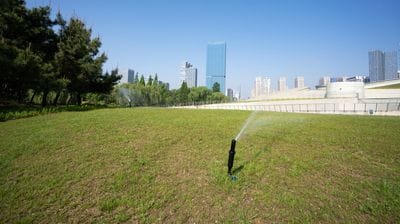
AB 1572, enacted in 2023, is intended to reduce the use of treated drinking water on grass that does not serve a recreational or community purpose. The law will bar schools and other public and institutional properties from using treated (potable) drinking water on “nonfunctional” turf—the purely decorative grass that serves no recreational or community purpose. The bill’s rationale for saving water is familiar: Too many dry years, and in a normal year roughly half of all publicly supplied water goes outdoors, mostly onto landscaping.
The potential impact on school districts depends on whether it is functional or nonfunctional. “Functional turf” is grass in areas designated for recreation or community use — such as sports fields, playgrounds, picnic areas, and locations designated for student recreation or community gatherings — and is not subject to the prohibition. Using potable water on “nonfunctional” turf—decorative grass in medians, parking-lot areas, along buildings or sidewalks, or in areas permanently closed to human access—will not be permitted. The law bans the drinking water, not the grass itself — removal is not required — and potable water may still be used to keep trees and other perennial plantings healthy or to meet an immediate health-and-safety need.
The prohibition phases in by property type — January 1, 2027, for local and regional public agencies; January 1, 2028, for other institutional properties; and later dates for other categories. Which date applies to a school district is a key question to pin down: Schools are institutional water users (pointing to January 1, 2028), but a school district may also qualify as a local public agency (January 1, 2027). And schools in disadvantaged communities (meaning communities with an annual median household income that is less than 80 percent of the statewide annual median household income) may have a later date. So each school district should confirm its own compliance date. The State Water Board may also postpone a deadline up to three years for good cause.
Covered institutional properties—including schools—with more than 5,000 square feet of irrigated area must certify compliance to the State Water Resources Control Board beginning June 30, 2030, and every three years thereafter. Public water systems, cities, and counties may enforce the prohibition, and noncompliance may bring civil penalties — up to $500 per day under the Water Code, or penalties a water supplier sets locally.
Supporters say that the measure will save “both water and money” and help California respond to recurring drought and long-term water-supply pressures. Opponents characterize it as a “one-size-fits-all” mandate that may not account for local conditions and may increase landscaping costs.
For More Information
The State Water Resources Control Board provides implementation timelines, examples of functional and nonfunctional turf, and frequently asked questions on its Nonfunctional Turf Bill webpage and in its Nonfunctional Turf Ban FAQ. Districts may also consult their public water system regarding whether particular landscaped areas qualify as nonfunctional turf.
Sources: California Water Code sections 10608.12 and 10608.14; State Water Resources Control Board guidance and FAQ (https://www.waterboards.ca.gov/conservation/nonfunctional-turf.html); Senate Floor Analysis of AB 1572 (Sept. 6, 2023).